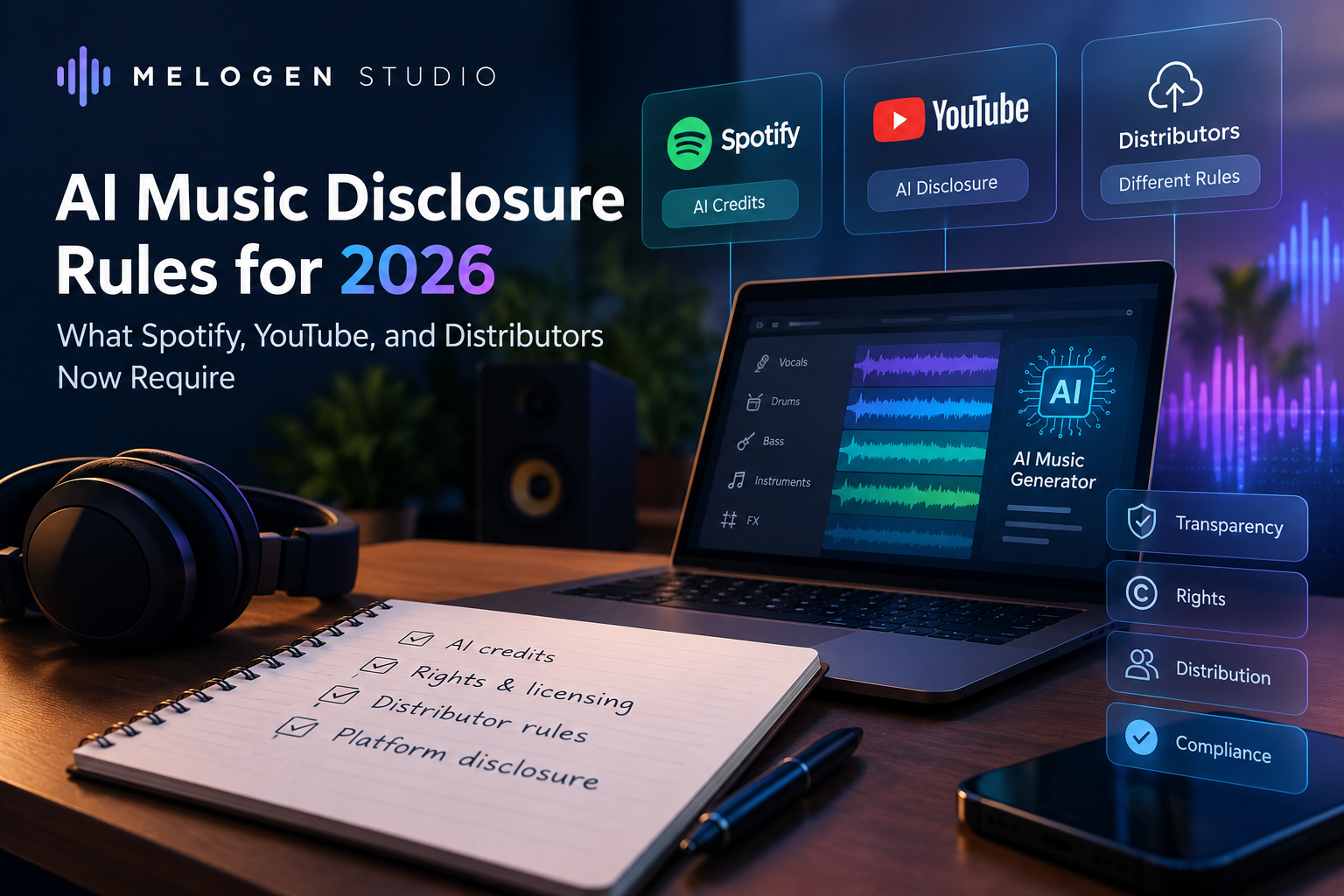
AI music has moved from an experimental production method to something creators can use across streaming platforms, social media, podcasts, games, and commercial projects. As its use has grown, platforms have started introducing clearer requirements around disclosure, artist identity, rights, and distribution.
In 2026, the important question is no longer simply whether AI music is allowed. It is how the music was created, what rights you have, and what information you need to disclose when publishing it.
Spotify, YouTube, and music distributors do not all use the same system. Understanding those differences can help you avoid unnecessary distribution problems and make your releases more transparent.
What Has Changed for AI Music in 2026?
There is no single industry-wide label that automatically applies to every AI-assisted song.
Instead, platforms are increasingly looking at different parts of the creation process. AI may have generated vocals, lyrics, instrumentation, composition, or production, for example. Some services therefore focus on identifying the specific contribution made by AI rather than simply marking an entire track as “AI-generated.”
Spotify has been moving toward this more detailed approach through AI credits. The platform supports industry-standard disclosure information developed through DDEX, allowing AI involvement in areas such as vocals, instrumentation, composition, and post-production to be identified.
That distinction matters because using AI as one part of a production process is different from publishing a track that was almost entirely generated by a model.
For creators using an AI music generator such as Melogen Studio, keeping track of what was generated and how the resulting track was used can make these distinctions easier to understand when preparing music for publication.
Spotify: AI Credits and Artist Identity
Spotify's 2026 approach has two separate areas creators should understand: how AI was used to make the music and whether the artist identity itself is AI-generated.
AI Credits
Spotify’s AI Credits allow artists and rightsholders to disclose specific ways AI contributed to a track, including vocals, lyrics, instrumentation, production, or post-production. Spotify reports that tens of thousands of AI credits are submitted daily, while noting that the absence of a credit does not prove that AI was not used because disclosure depends on artists, labels, and distributors.
AI Artist Personas
Starting in mid-September 2026, Spotify began displaying an AI Persona badge on selected artist profiles whose public identity may represent a photorealistic AI-generated person. Artists can disclose this status through Spotify for Artists, while Spotify can also review profiles and apply the badge. Spotify emphasizes that the badge concerns the artist’s public identity—not how the music was produced—and is therefore distinct from AI Credits, which describe AI’s role in an individual song.
Voice Cloning Is a Separate Issue
AI disclosure does not give someone permission to imitate another artist.
Spotify's policy states that vocal impersonation is only permitted when the impersonated artist has authorized its use. This is particularly important for AI-generated vocals that attempt to reproduce a recognizable artist's voice.
So, before releasing an AI-generated song, creators should consider both AI transparency and rights to the voices, recordings, samples, and other material used.
For a deeper look at the distinction between having permission to commercially use AI music and actually owning copyright in it, see our guide to commercial use vs. copyright in AI music.
YouTube: AI-Generated Music Requires Disclosure
YouTube takes a somewhat different approach.
It requires creators to disclose realistic content that is generated or meaningfully altered with AI. During the upload process, creators can make this disclosure through the AI use setting in YouTube Studio’s Attributes section, after which YouTube may add an AI-generated or altered-content label.
YouTube specifically includes AI-generated music among the content requiring disclosure, while distinguishing it from limited uses such as minor pitch correction or AI-assisted mastering. For music partners, YouTube further distinguishes between fully and partly generative-AI content.support.google+1
Does an AI Label Mean You Cannot Monetize?
Not automatically.
YouTube states that making the required AI disclosure does not, by itself, limit a video's audience or make it ineligible for monetization. However, creators can face enforcement if they repeatedly fail to disclose content that requires disclosure.
This makes accurate disclosure preferable to trying to hide AI involvement.
What About Music Distributors?
This is where things become particularly important for independent artists.
A distributor is not necessarily following exactly the same rules as Spotify or YouTube. Each distributor can have its own requirements for accepting AI-generated material.
DistroKid
DistroKid currently accepts music created using AI tools, but its requirements include having the necessary rights to the material, avoiding unauthorized imitation, avoiding copyright infringement, and not using mass-generated music to manipulate streaming services.
DistroKid also provides AI Credits for eligible releases. These can identify AI-generated vocals, lyrics, instrumental material, or compositions, while ordinary AI-assisted production such as mixing or mastering does not necessarily require an AI credit under its current guidance.
TuneCore
TuneCore takes a different approach.
Its current GenAI framework permits AI-created music when the underlying model uses fully licensed training datasets. TuneCore says creators are responsible for checking whether the AI system they use meets that requirement.
This is an important reminder that the AI tool you use can matter to distribution eligibility.
A track may have commercial-use permission from an AI music service, but that does not automatically mean every distributor will accept it under its own policies.
This is also why understanding how an AI music system is trained can be relevant when selecting a tool. Our guide on [AI music training data and copyright] explores this issue in more detail.
CD Baby
CD Baby currently takes a considerably more restrictive position. Its support documentation states that it does not accept AI-generated content for distribution, even when that content is commercially licensed.
This illustrates an important point: there is no universal distributor policy for AI music in 2026.
Before submitting a release, check the current rules of the specific distributor you plan to use rather than assuming that acceptance by one service means another will accept the same track.
AI Disclosure Is Not the Same as Copyright
One of the easiest mistakes is treating an AI label as proof that a song is copyrighted, licensed, or legally cleared.
These are separate questions.
Disclosure asks:Was AI involved, and how?
Licensing asks:Do you have permission to use the generated material commercially?
Copyright asks:What parts of the work qualify for copyright protection under the applicable law?
Distribution asks:Does the distributor and destination platform allow this material to be released?
A track can therefore have permission for commercial use while still raising separate questions about copyright protection.
If you're using AI music commercially, these distinctions are worth understanding before publishing a track.
What Creators Should Keep Track of Before Releasing AI Music
A simple record of your production process can make distribution much easier.
Before releasing an AI-assisted or AI-generated track, keep track of:
- Which AI music tool was used
- What parts of the track were generated by AI
- Whether lyrics were generated or written by a person
- Whether vocals were generated, recorded, or AI-assisted
- Whether any recognizable artist's voice was used
- What samples, loops, or third-party material were included
- What the AI service's current commercial-use terms allow
- Whether your distributor accepts AI-generated music
- Whether AI disclosure information is required
- Whether the destination platform requires a separate disclosure
It is also worth checking the AI provider's terms at the time you create the music. Terms can change, and distributor requirements can change with them.
For creators producing music with Melogen Studio, this same habit can be useful: keep a record of the generation process and review the current terms before using a track for a commercial release or distributing it through a third-party service.
What About AI Music Used in YouTube Videos?
If you're generating music for your own YouTube videos rather than releasing the song as a standalone streaming track, there are still two separate considerations.
First, check the AI music service's usage rights.
Second, follow YouTube's disclosure requirements when applicable.
This becomes particularly relevant when AI music is combined with other synthetic media, such as an AI-generated vocalist, realistic avatar, or simulated performance.
For creators using royalty-free or AI music in online videos, copyright claims and platform-specific restrictions can also create problems even when the music was obtained legally. Our guide to royalty-free music, YouTube claims, and Twitch mutes covers some of these issues.
Do You Need to Disclose Every Use of AI?
Not necessarily in exactly the same way.
The answer depends on the platform and what the AI actually contributed.
For example, YouTube distinguishes between meaningful AI-generated or altered content and minor uses such as certain editing and production assistance. Spotify's AI Credits are designed to communicate specific AI contributions rather than forcing every song into a simple AI/non-AI category.
That is why creators should avoid relying on a single rule such as “AI was used, so label everything AI” or “AI was only used for production, so disclosure never matters.”
The safest approach is to check the requirements of the platform where you are publishing.
What This Means for AI Music Creators in 2026
The direction of the industry is becoming clearer: platforms are moving toward greater transparency about how music is created, while distributors are developing their own eligibility requirements.
Spotify is expanding AI credits and introducing additional transparency around AI artist identities. YouTube explicitly includes AI-generated music within its disclosure system. Distributors are taking different approaches, ranging from accepting AI music under specific conditions to rejecting AI-generated material entirely.
For creators, the practical lesson is straightforward: don't treat “AI-generated” as a complete description of your rights or your distribution status.
Know what the AI contributed. Keep track of the rights attached to your output. Avoid unauthorized voices and copyrighted material. Then check the current rules of the platform or distributor where you intend to publish.
As AI music becomes a normal part of creative workflows, being able to explain how a track was made and what rights you have to use it is likely to become just as important as the track itself.
And if you are preparing AI-generated music for editing or a wider production workflow, understanding how individual elements can be separated can also be useful. See our AI stem separation guide to learn more about working with vocals, instruments, and other track elements.