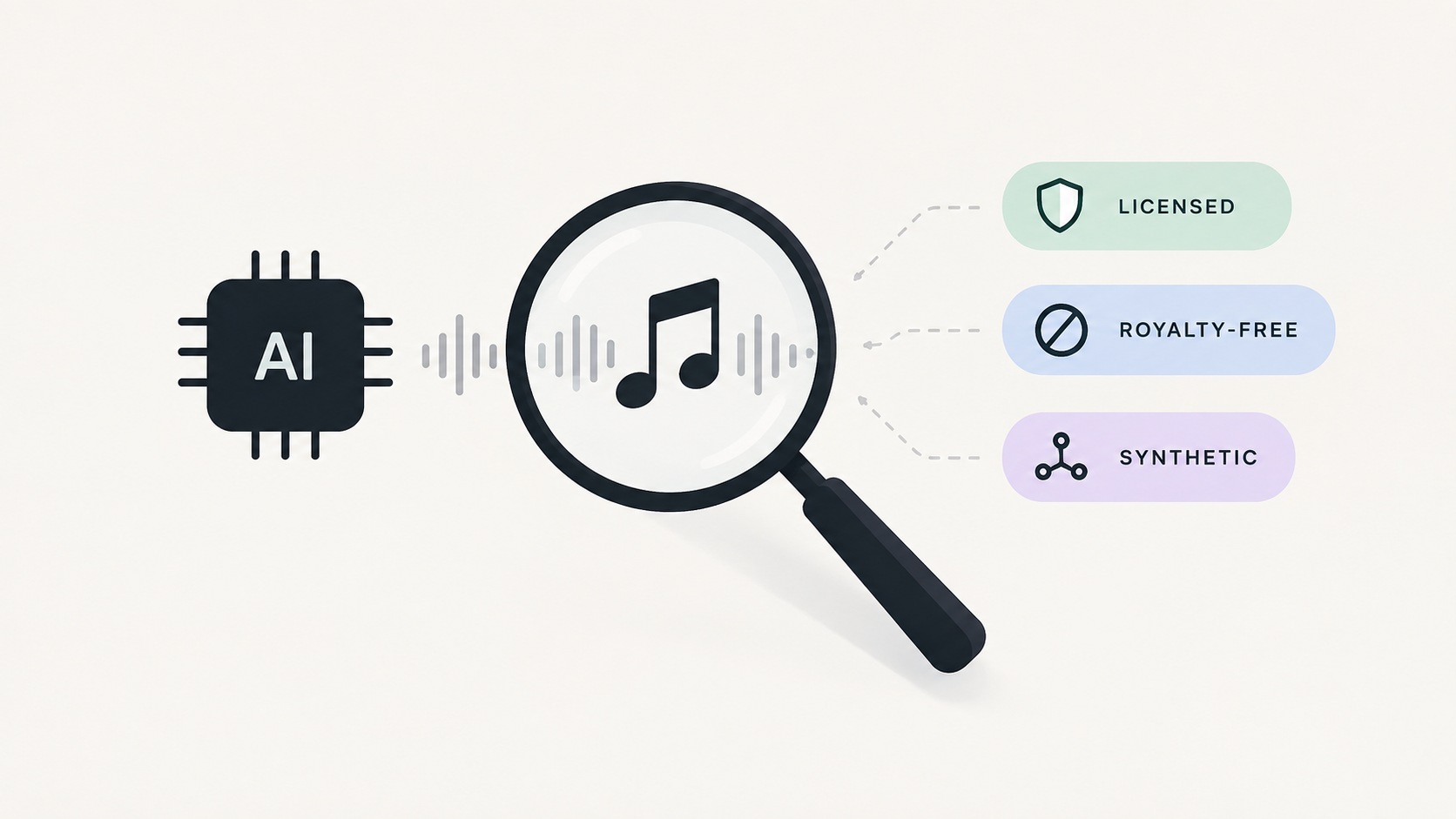
If you use AI-generated music commercially, one question matters before you publish, monetize, or license a track:
Where did the AI learn to make music?
That question is becoming harder to ignore. In July 2026, the Munich Regional Court ruled largely in favor of GEMA in its case against Suno, finding that protected musical works had been used without authorization in ways that implicated German copyright law, including in the training of Suno's model. The ruling is not the end of the legal debate, but it demonstrates why the provenance of an AI music model's training data matters to commercial users.
For creators, the practical lesson is simple: don't look only at what an AI music tool lets you do with its output. Look at what the provider says about how the underlying model was trained.
Why Training Data Matters
AI music models learn patterns from large collections of musical material. That can include recordings, compositions, metadata, lyrics, synthetic material, or combinations of these.
The important distinction is how that material was obtained.
A provider might train a model using:
- Licensed music obtained with permission from rights holders
- Royalty-free or public-domain material
- Synthetic music created specifically for training
- User-submitted material, depending on the platform's terms
- Publicly available or scraped material, where the legal status may be less clear
These categories are not interchangeable.
A model being commercially available does not automatically tell you that its training data was licensed. Likewise, a provider giving you commercial rights to generated music does not necessarily answer every question about the model's training history.
That's why commercial users should separate two questions:
"Can I commercially use this output?"
and
"How was the model that generated this output trained?"
Both deserve an answer.
The First Question to Ask: Does the Provider Actually Explain Its Training Data?
Start with the provider's documentation.
Look for a clear statement about the sources used to train the model. Ideally, the provider should explain whether the training data consists of licensed, royalty-free, public-domain, synthetic, user-provided, or other material.
Be cautious when the answer is simply:
"Our music is safe for commercial use."
That may describe the rights granted to you as a user without explaining the model's underlying data.
A stronger answer gives you information about provenance, not just output licensing.
You do not necessarily need the provider to publish every track in its training dataset. Large models can involve enormous collections of data. But a meaningful explanation of the categories and sourcing of that data gives commercial users something to evaluate.
Know What’s Behind the Music You Generate
Melogen Studio uses ACE-Step v1.5, whose project documentation describes licensed, royalty-free/no-copyright, and synthetic sources in its training data. Explore Melogen Studio and see how AI music creation fits into your commercial workflow.
Explore Melogen StudioThe Second Question: Is "Royalty-Free" Being Used Correctly?
"Royalty-free" is useful terminology, but it should not be treated as a synonym for "copyright-free."
Royalty-free generally refers to the payment structure attached to a license. A royalty-free track can still be copyrighted and subject to specific license conditions.
That distinction matters when evaluating an AI music provider.
If a company says its model was trained on royalty-free music, ask what that means in practice:
- Was the music properly licensed for AI training?
- Was it public-domain material?
- Were the licenses broad enough to cover model training?
- Was synthetic data also used?
- Does the provider distinguish training-data rights from output rights?
These questions help you move beyond reassuring labels and toward the actual licensing structure.
For a deeper look at another side of the issue, see our guide to commercial use vs. copyright in AI music, which explains why having commercial-use permission does not automatically mean that every copyright question disappears.
The Third Question: Does the Provider Distinguish Training Rights From Output Rights?
This is one of the most important distinctions for commercial creators.
Suppose an AI music service gives you permission to use generated tracks commercially. That tells you something important about the relationship between you and the provider.
It does not necessarily answer every legal question surrounding the model's development.
Think of the process as having two separate layers:
Training layer:
What music and other data were used to develop the model?
Output layer:
What rights does the provider give you over the music the model generates?
A responsible buyer should examine both.
This is particularly important if you're using AI music in advertising, YouTube channels, games, client projects, podcasts, or other commercial work where a dispute over rights could create more than just an inconvenience.
The Fourth Question: Can the Provider Tell You What Model Is Actually Being Used?
Another useful question is whether the provider identifies the underlying model.
"Powered by proprietary AI" tells you very little.
If the provider identifies its model or technology, you can investigate the model's documentation, license, technical reports, and stated training-data practices.
For example, Melogen Studio uses ACE-Step v1.5 as its underlying music-generation model. The ACE-Step project states that v1.5 was trained using a legally compliant dataset made up of licensed music, royalty-free/no-copyright material, and synthetic audio generated through MIDI-to-audio conversion.
That is a materially more useful answer to the provenance question than simply saying that an AI music generator is "safe."
However, it is important to phrase this accurately: this is the ACE-Step project's stated representation of its training-data provenance. It should not be treated as an absolute guarantee that eliminates every possible copyright or legal risk.
That distinction matters.
No AI music provider can make the broader legal landscape disappear with a marketing statement.
What About Models Trained on Scraped Music?
This is where commercial users should pay particular attention.
If a provider cannot explain where its training music came from, that does not automatically prove that the model was trained unlawfully.
But it does mean you have less information with which to evaluate your risk.
The recent Suno litigation illustrates why this matters. GEMA argued that Suno had used protected works from its repertoire for training without obtaining the necessary licenses, and the Munich court ultimately ruled in GEMA's favor on key issues in July 2026. The decision remains subject to the legal process and does not establish that every AI model trained on copyrighted material is unlawful in every jurisdiction.
For a buyer, the takeaway is not "never use an AI music tool."
It is:
Ask what the provider knows about its own training data before you depend on the service commercially.
Make AI Music With a Clearer Provenance Story
Melogen Studio uses ACE-Step v1.5 for AI music generation, whose project documentation describes licensed, royalty-free/no-copyright, and synthetic training sources. Explore Melogen Studio and create music for your next project.
Try Melogen StudioA Practical AI Music Training-Data Checklist
Before choosing an AI music platform for commercial work, ask:
1. What was the model trained on?
Look for a specific explanation rather than a generic "commercially safe" claim.
2. Was the training material licensed?
If yes, does the provider say that AI training was covered by those licenses?
3. Was royalty-free or public-domain material used?
Find out how the provider defines those categories.
4. Was synthetic training data used?
Synthetic data can reduce dependence on existing copyrighted recordings, although it does not by itself answer every legal question.
5. Was user-uploaded music included in training?
If so, check what users agree to when uploading material.
6. Does the provider identify the underlying model?
An identifiable model gives you more documentation to investigate.
7. What commercial rights do you receive for generated music?
Check the actual terms rather than relying on advertising language.
8. Are there restrictions on the output?
Look for limitations involving distribution, monetization, client work, advertising, or content platforms.
9. Does the provider make guarantees it cannot realistically support?
Be skeptical of absolute claims such as "100% copyright-proof."
10. Can you keep documentation of the provider's terms?
For commercial projects, save the relevant terms and licensing information that applied when you generated the music.
Don't Stop at "Royalty-Free"
Training-data provenance is only one part of the picture.
Even when a model has a favorable training-data story, the resulting track can still raise separate questions. For example, your prompt, lyrics, reference audio, samples, vocals, or other material could introduce rights issues independently of the model's training data.
That's why commercial AI music users should also understand the difference between royalty-free music and platform copyright claims. A track being described as royalty-free does not guarantee that YouTube, Twitch, or another platform will never flag it.
The safest approach is to evaluate the entire chain:
Training data → Model → Generated output → Your inputs → Commercial license → Distribution platform
Each stage can introduce a different consideration.
So, What Should Commercial Buyers Look For?
There is no single phrase that makes an AI music service risk-free.
But transparency is a useful signal.
A provider that can identify its underlying model, explain its training-data categories, provide clear commercial-use terms, and avoid absolute legal guarantees gives commercial users considerably more information to work with.
Melogen Studio's use of ACE-Step v1.5 provides one example of this approach. The underlying model's project documentation explicitly describes licensed, royalty-free/no-copyright, and synthetic sources in its training data. That does not constitute an unconditional legal guarantee, but it is a meaningful provenance disclosure for creators who are evaluating AI music tools for commercial use.
Ultimately, the right question isn't simply:
"Does this AI music tool let me monetize my songs?"
Ask the harder question first:
"Can this company explain where the model learned to make them?"
For commercial creators, that answer may be just as important as the quality of the music itself.